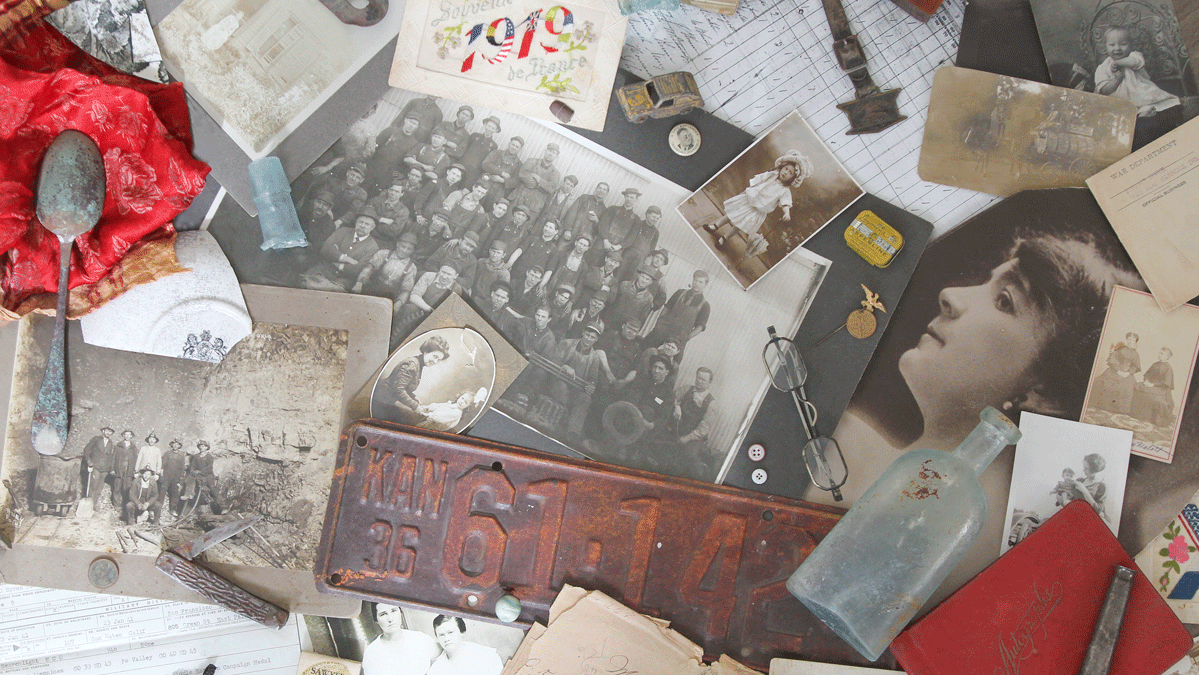
As the genealogist in the family, I became the recipient and temporary holder of family pictures as successive grandparents have passed away. While I was fortunate to go through and label a great deal of family photos with my relatives before they passed, many remain unidentified. These unidentified heirlooms became unfortunate casualties of lapsed memories and opportunities.
A few unlabeled outliers are a series of panoramic images that featured my grandfather and great uncle. A portion of one is included below. Now I’m not even sure how these even survived the passage of time mostly unscathed. Sure, there are water marks and mold stains and torn or bent corners, but they are remarkable in their condition. When you factor in the size (7” x 17”) and the instability that punctuated the first 25 years of his life, it’s extremely unlikely that they survived at all! It’s probably a testament to how much he valued them and the memories he shared with his brother who died in an auto wreck in 1936 at age 25. Unlike a lot of the photographs in my possession, however, I don’t recall a single instance of my grandfather talking about this particular set. I had viewed mining related photographs and heard many times over stories of how his father died of miner’s lung before my grandfather had reached his 11th birthday or how he and a brother had once turned over the outhouse door-side down while a teacher was inside. There were also his colorful stories of the adventures he shared with his brother riding the rails from northeastern Oklahoma in search of work (and food) at some point during his teenage years. I remember hearing that they picked spuds in Idaho, chopped hay in Wyoming and Nevada, were offered marijuana by hobos while riding in a boxcar through the plains, and even slept in a jail when a kind sheriff offered them a bed for a night. But South Dakota? Nope, didn’t ring any bells whatsoever.
Earlier this year, I made it my mission to finally put a date to these images.
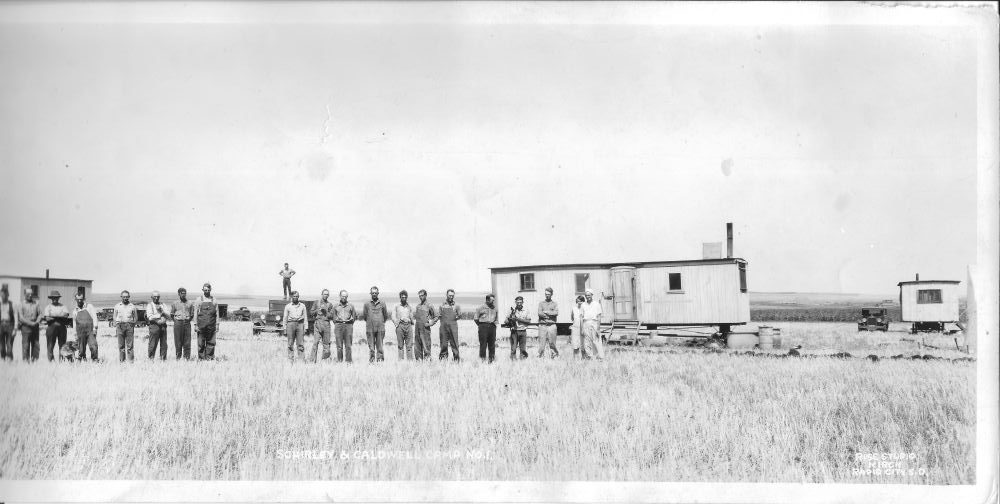
A good starting point is always with what you do know. My grandfather was born in 1913 and I know that he set off with his brother during their teenage years. My guess was that he was between 18-22 years at the time. I know he joined the Civilian Conservation Corps (CCC’s) in March of 1935 so my guestimate was between 1931 and March 1935.
My initial Google and newspaper archives searches for the name of the company listed on the photograph, Schirley & Caldwell, proved fruitless. Various combinations of searches involving the name of the railroad, Chicago and Northwest (C & NW RR) gave similar results. I eventually stumbled upon the following blurb from of all places, a K12 school site with a story about local history.
The decision in 1929 to build the extension of the Chicago and Northwestern Railroad line from Winner to Wood on a path that missed “Old” Witten by about two miles to the south sealed the fate of “Old” Witten to the dustbin of history. The Shirley-Caldwell Co. was the contractor for the railroad grade to a point five miles west of Winner. The contractor further west was England Construction Co. Mules were used to haul the dirt for the rail bed. Morganfield Brothers Engineering, contractors from Winner, employed over 300 men to build the railroad bridges from Winner to Wood during the summer of 1929.
This was enlightening as it provided an approximate year- 1929. Secondly, I learned that the name of the company printed on two of the images turned out to have an ever so slight spelling error. Not a big deal though as Google searches with the correct spelling also yielding nothing. A collaborator and friend of the Windmill Research Collective scouring newspaper and historical archives specific to South Dakota turned up a few interesting tidbits which not only verified that the work was done in 1929 but also narrowed down the dates.
4/11/1929 Chicago and North Western railroad granted permission by the interstate commerce commission to extend a branch line in South Dakota 34 miles from Winner to Wood. (The Daily Plainsman)
4/18/1929 Steel rails for Winner-Wood extension unloaded in Winner. (Tripp County Journal)
4/18/1929 Contract let for laying track, grading, bridgework, ballast and fencing between Winner and Wood. (Tripp County Journal)
4/26/1929 Grading work started in preparation for the extension of the Chicago & North West railroad from this place (Winner) to the inland town of Wood. (Argus-Leader)
6/27/1929 Railroad extension from Winner to Wood is proceeding rapidly. (Tripp County Journal)
8/22/1929 130 laborers arrive in Winner to lay railroad track between Winner and Wood. (Tripp County Journal)
8/29/1929 Laying of steel railroad tracks between Winner and Wood starts. (Tripp Count Journal)
Taking into consideration the labeling on the images which reads, “Schirley (sic) & Caldwell Grading Crew No. 1” and the logical assumption that grading and preparation of the land would have taken place prior to the laying of tracks, I now had a narrowed time frame between 4/18/1929-6/27/1929. As my grandfather was born in June 1913, that meant he was working alongside these men some 700 miles away from home when he and his brother were 15 and 17 respectively. I had heard the stories and knew his early years were challenging but my prior assumption that he was probably closer to being 20 somehow had made it more palatable…or at least less sad than how I now felt.
My lingering doubts about the accuracy of my dating of the photographs were put to rest when I conducted some research on the photographer’s signature.
Rise Studio
-Kirch-
Rapid City S.D.
On his website, researcher Jim Potter indicated that photographer William Kirch moved to Wood in 1929 and only used the tag line ‘Rise Studio- Kirch’ for a year or two. With that final confirmation, I had little doubt that the half a dozen panoramas in my possession were indeed slices of life of two young Okies who not only road the rails but helped construct them during the Spring of 1929.
Photographer William Kirch moved to Wood in 1929 and used “Rise Studio- Kirch” on his photos only for a year or two.
Postnote:
I received an email from a car enthusiast who confirmed after I sent him an enlarged photo that the vehicle in the far right corner of the picture was either a 1928 or a 1929 Ford Model A.
Sources:
https://genealogytrails.com/sdak/tripp/histsoc_np_idx_index.htm
https://jimpotterauthor.com/kirch